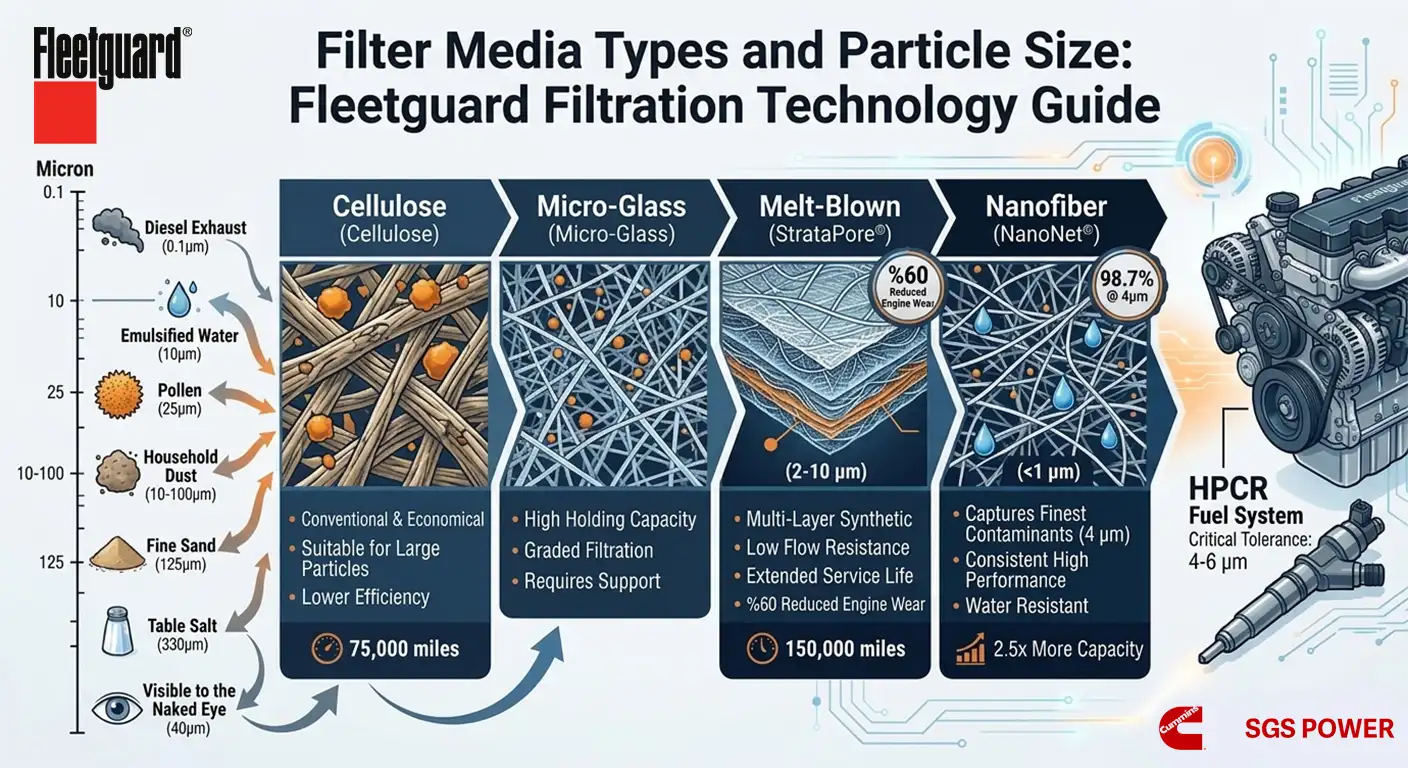
Choosing the right filtration technology is essential for extending diesel engine life and maintaining peak performance. Today’s high-efficiency diesel engines are extremely sensitive to contaminants as small as a few microns. In this guide, we explore the different filter media types offered by Fleetguard, the concept of the micron, and how particle size directly impacts filtration requirements.
What Is a Micron and Why Does It Matter for Filtration?
A micron (micrometer, µm) is a unit of length equal to one millionth of a meter. In numerical terms, 1 µm = 0.001 mm = 0.000001 m. There are approximately 25,400 microns in a single inch. In the filtration industry, the micron is the fundamental unit used to define the smallest particle size a filter medium can capture.
Diesel engines require extremely fine filtration to protect fuel system components such as injectors, fuel pumps, and common rail systems. Critical particle sizes in modern injection systems range between 4 and 6 microns — particles far too small to be seen by the naked eye.
Everyday Particle Size Examples
To understand just how small a micron is, it helps to look at some common reference points from daily life:
- Table salt grain: Approximately 330 µm in diameter — easily visible to the naked eye.
- Fine sand (quartz): Ranges from 250 to 125 µm.
- Household dust: Varies widely from 100 to 10 µm.
- Pollen: Typically 25 to 20 µm in size.
- Urea crystal: Between 20 and 10 µm.
- Emulsified water droplet: Around 10 µm — invisible to the naked eye.
- Flavobacterium species: Range from 10 to 2 µm.
- Ultra-fine carboxylate globule: Between 2 and 1 µm — only visible under an electron microscope.
- Diesel exhaust particle: Approximately 0.1 µm, among the smallest contaminants.
The smallest particle the human eye can detect is roughly 40 µm. This means the vast majority of contaminants that damage diesel engines are completely invisible and can only be captured by high-quality filters.
Contaminant Tolerances in Modern Diesel Engines
Today’s high-efficiency diesel engines and related systems operate with extremely tight tolerances, making them vulnerable to premature wear and performance loss from microscopic contaminants. These tolerances vary by component:
- Lubrication system components (bearings, crankshaft, etc.): Tolerances range from 25 to 20 µm — even particles at this scale can cause significant wear.
- Hydraulic pistons: Operate with very fine tolerances between 12 and 6 µm.
- High-pressure common rail (HPCR) fuel injection systems: Feature extremely tight tolerances of 6 to 4 µm, demanding the highest level of filtration quality.
These figures clearly demonstrate why filter selection is so critical. When an inadequate filter is used, particles larger than the system’s tolerance limits can pass through and cause injector failure, pump damage, and accelerated engine wear.
The Relationship Between Particle Size and Filter Media Design
Liquid filters are rated based on the efficiency with which they remove particles of a specific size. Both the particle size in microns and the efficiency value (beta ratio or percentage) must be considered together. In other words, a filter’s micron rating alone is not enough — how effectively it captures particles at that size is equally important.
Fleetguard’s filtration engineering follows a fundamental design principle: the diameter of a single strand of filter media should be approximately one-tenth (1/10) the size of the target particle. For this reason, multiple media types are used together in a single filter to achieve optimal protection across a wide range of contaminant sizes.
Fleetguard Filter Media Types: A Comprehensive Comparison
Fleetguard offers four core media types tailored to different filtration needs. Moving from left to right across the range, filtration efficiency, holding capacity, and the ability to capture smaller particles all increase progressively.
1. Cellulose Media
Cellulose media is the most traditional and longest-established material in the filtration industry. Made from natural cellulose fibers, it provides a low-cost solution primarily suited for capturing larger contaminants.
- A traditional, economical filtration solution best suited for larger particles.
- Less efficient than modern synthetic and nanofiber media types.
- Cellulose fibers can degrade over time through prolonged contact with fluids, leading to reduced performance.
- Can be combined with other media types to improve overall filtration performance.
While cellulose media offers a cost advantage, it often falls short of meeting the high filtration standards required by modern diesel engines on its own. For more demanding applications, synthetic media types are the preferred choice.
2. Micro-Glass Media
Micro-glass media is a synthetic filter material composed of very thin fiberglass strands woven into a complex mesh structure. It offers significant improvements over cellulose in several key areas.
- Delivers greater particle-holding capacity and filtration efficiency compared to cellulose media.
- Smaller, more uniform fibers make it more effective than wet-laid paper-type media.
- Can be layered in multiple stages to achieve progressively finer filtration.
- Requires a polymer or metal backing material to maintain its shape due to its flexible structure.
3. Melt-Blown Media – Fleetguard StrataPore®
Fleetguard’s proprietary StrataPore® technology is a multi-layered synthetic media produced using the melt-blown manufacturing process. This technology represents a major advancement in filtration performance.
- Composed of fine, continuous (unbroken) fibers that capture contaminants with significantly higher efficiency.
- Fiber diameters range from 2 to 10 µm — approximately one-fifth the size of cellulose fibers.
- Each layer targets different particle sizes, providing gradient filtration that achieves both high efficiency and low flow restriction.
- Its 100% polymeric structure requires no resins or adhesives, resists degradation from fluids, and maintains integrity over time.
- Approved for extended service intervals — while cellulose media typically lasts up to 75,000 miles, StrataPore media can perform for up to 150,000 miles.
StrataPore technology is widely used in Fleetguard fuel filters, lube filters, and water separators. Thanks to its gradient filtration design, it can reduce engine wear by up to 60% in certain applications.
4. Nanofiber Media – Fleetguard NanoNet®
Fleetguard’s most advanced filtration technology, NanoNet®, is made from continuous sub-micron diameter nanofibers and delivers maximum protection for modern engines and systems.
- Sub-micron continuous fibers capture even the finest contaminants, providing top-tier protection for engines and system components.
- Achieves the optimal balance between particle removal, holding capacity, and flow restriction.
- Performance does not decline with use — unlike conventional filters, efficiency remains consistent throughout the entire service life.
- Its 100% synthetic composition makes it resistant to water, eliminating the waterlogging issues common with cellulose-based filters.
- Capable of capturing 98.7% of all particles as small as 4 microns.
- Offers 2.5 times the contaminant-holding capacity of conventional filters.
- When paired with StrataPore media, it delivers the ideal combination of efficiency, capacity, and flow restriction.
NanoNet technology is indispensable for protecting components that operate with extremely tight tolerances, such as high-pressure common rail fuel injection systems.
Filter Media Types Comparison Overview
Below is a summary of the performance characteristics of the four core media types:
- Cellulose: Low cost, lower efficiency, suitable for larger particles. Coarse fiber diameter, may degrade over time.
- Micro-Glass: Moderate cost, medium-to-high efficiency, finer filtration than cellulose. Requires structural backing.
- Melt-Blown (StrataPore®): High efficiency, 2–10 µm fiber diameter, long service life, gradient filtration. Highly resistant to degradation.
- Nanofiber (NanoNet®): Highest efficiency, sub-micron fiber diameter, consistent performance, filtration down to 4 µm. Waterproof structure.
Why Choosing the Right Filter Is Critical
Using a low-quality or mismatched filter may seem like a cost-saving measure in the short term, but it leads to far greater expenses over time. The consequences of inadequate filtration include injector failure, fuel pump damage, accelerated engine wear, unplanned downtime, and increased maintenance costs.
In modern diesel engines equipped with high-pressure common rail systems, particles as small as 4–6 microns can cause serious damage. This is why Fleetguard’s advanced media technologies like StrataPore and NanoNet represent the most sound investment for extending engine life and reducing total cost of ownership.
Why Choose Genuine Fleetguard Filters?
Fleetguard filters are genuine products manufactured by Cummins that meet OEM quality standards. Backed by Cummins’ filtration expertise dating back to the 1950s and ongoing R&D investments, Fleetguard stands as one of the most trusted filtration brands in the industry.
- All media types are produced in Cummins’ own manufacturing facilities and undergo rigorous quality control processes.
- Proprietary technologies such as StrataPore and NanoNet are exclusive to Fleetguard products.
- Full compliance with OEM specifications ensures warranty conditions are preserved.
- Extended service intervals reduce total maintenance costs and maximize equipment uptime.
SGS Power: Your Authorized Cummins Dealer and Fleetguard Supplier in Turkey
At SGS Power, we serve as an authorized Cummins sales and service dealer with over 20 years of industry experience. From our headquarters in Tuzla, Istanbul, and our production and service facility in the Tuzla Free Zone, we provide comprehensive solutions in marine engines, generators, genuine spare parts, and Fleetguard filtration products.
Contact us for all genuine Cummins spare parts, including Fleetguard filters. Let us help you determine the right filtration solution to extend your engine’s life and maintain its performance.